

Keto Macros Explained: Calculate Yours in 4 Easy Steps
Medical note: I’m Tristina — a home cook and keto researcher, not a doctor or dietitian. This guide explains keto macros in plain English; it’s educational, not medical advice. If you take medication or have a health condition, please talk to your doctor first (I cover exactly who should be careful near the end).
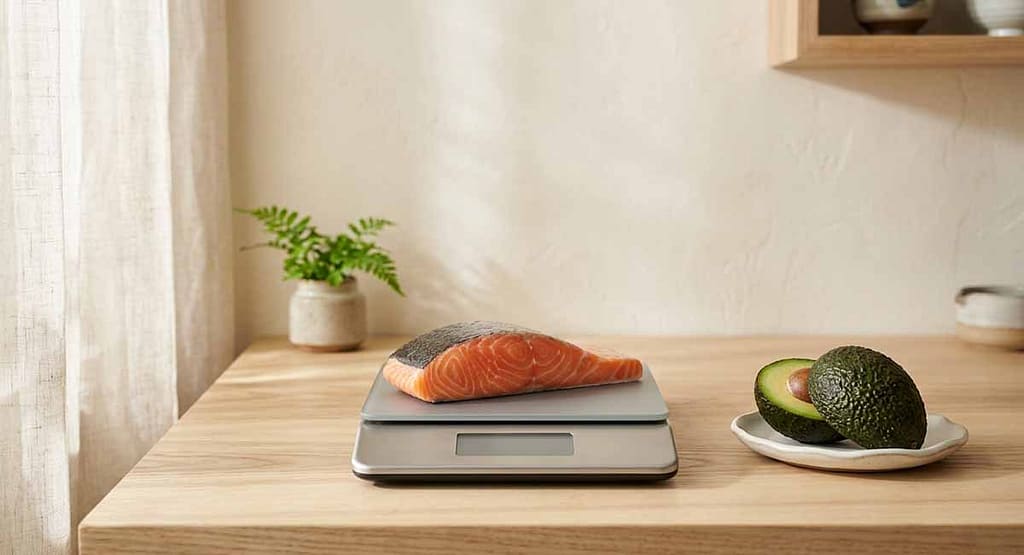
What are keto macros? Keto macros are the three macronutrients you balance on a ketogenic diet — fat, protein, and carbs. The standard keto ratio is roughly 70–80% of your calories from fat, 10–20% from protein, and 5–10% from carbs, while keeping net carbs under about 20–30 grams a day. Hit those numbers and your body shifts into fat-burning ketosis.
If the word “macros” makes your eyes glaze over, I get it — it sounds like homework. But here’s the honest truth: keto really comes down to a few simple numbers, and once you’ve seen them calculated one time, you’ll never be confused again. In this guide I’ll show you the standard keto macros ratio, how to calculate your own in four steps (by hand, no black-box calculator), a save-worthy cheat sheet, and the honest answer to a question almost nobody asks: do you even need to count them? Think of this as the numbers companion to my full keto for beginners guide.
📌 Want to skip the math entirely? Grab my free Keto Starter Kit — it hands you done-for-you daily targets (fat, protein, carbs) so you can start eating without touching a calculator.
Table of Contents
What Are Keto Macros? (Plain English)
“Macros” is just short for macronutrients — the three things in food that give you calories: fat, protein, and carbohydrates. On a normal diet, most of your energy comes from carbs. Keto flips that: you make fat your main fuel, keep protein moderate, and drop carbs low enough that your body switches to burning fat for energy. “Calculating your keto macros” simply means figuring out how many grams of each to eat per day.
The standard ketogenic split is 70–80% of calories from fat, 10–20% from protein, and 5–10% from carbs, per Harvard’s Nutrition Source. Those percentages are the whole game — everything else in this guide is just turning them into grams you can actually eat. The ratio stays the same whether you eat 1,500 or 2,500 calories a day; only the grams change to match. And no, you don’t have to be a math person to do it.
The Standard Keto Macro Ratio
The standard keto macro ratio is 70–80% fat, 10–20% protein, and 5–10% carbs, measured as a share of your daily calories (Harvard Nutrition Source). To turn a percentage into grams, you need one fact: how many calories each macro packs per gram. Fat has 9 calories per gram, while protein and carbs each have 4 calories per gram — the “9-4-4” rule from the USDA. Here’s the cheat sheet I wish I’d had on day one — screenshot it:
| Macro | Target (% of calories) | Calories per gram | Beginner rule of thumb |
|---|---|---|---|
| Fat | 70–80% | 9 cal/g | Your main fuel — fill the rest of your calories here |
| Protein | 10–20% | 4 cal/g | Moderate & steady (about 1.2–2.0 g per kg of goal body weight) |
| Carbs | 5–10% | 4 cal/g | Hard cap: under 20–30 g net carbs a day to start |
One honest note before you memorize percentages: for beginners, the carb number matters far more than the exact fat-to-protein split. Nail your carbs, keep protein reasonable, and let fat fill the gap — that’s really all it takes.
How to Calculate Your Keto Macros in 4 Steps
You can calculate your keto macros by hand in about five minutes — no app required. The trick most calculators use (but rarely explain) is to work in this order: carbs first, protein second, fat last. Here’s the exact process, with a real worked example for someone eating 1,800 calories a day to lose weight.

- Find your daily calories. Use a free TDEE (total daily energy expenditure) calculator, then subtract a little for weight loss. Example: 1,800 calories.
- Set carbs first (the hard cap). Start at 20–30 g net carbs. Example: 25 g × 4 = 100 calories.
- Set protein second (moderate). Aim for 10–20% of calories, or about 1.2–2.0 g per kg of goal body weight. Example: ~90 g × 4 = 360 calories.
- Fill the rest with fat. Subtract carb + protein calories from your total, then divide by 9. Example: 1,800 − 100 − 360 = 1,340 ÷ 9 = ~149 g fat.
Final macros for this example: ~149 g fat, ~90 g protein, 25 g net carbs — which lands right inside the standard keto ratio. That’s it. Swap in your own calories and body weight and the same four steps give you your personal numbers.
Your Keto Macros by Calorie Target
Don’t want to do the arithmetic? Find the calorie level closest to yours in the table below and you’ve got a solid starting point. This is the kind of thing competitors bury inside a calculator — I’d rather just hand it to you so you can save it to your phone. Remember, these are starting estimates, not rules carved in stone; your real targets depend on your height, activity, and goals.
| Daily calories | Fat (g) | Protein (g) | Net carbs (g) |
|---|---|---|---|
| 1,500 | ~125 g | ~56 g | 20–30 g |
| 1,800 | ~150 g | ~68 g | 20–30 g |
| 2,000 | 165 g | 75 g | 20–30 g |
| 2,500 | ~208 g | ~94 g | 20–30 g |
Fat and protein grams are calculated from a 75% fat / 15% protein split using the 9-4-4 rule; the 2,000-calorie row matches Harvard’s published keto example (165 g fat, 75 g protein). Rounded for real life — fine-tune with a calculator if you like precision.
📌 Want these numbers as a printable for the fridge? They’re baked into my free Keto Starter Kit, alongside a 7-day menu that already fits them — so you can eat to your macros without weighing every bite.
Net Carbs vs. Total Carbs (the Number That Trips Beginners Up)
This one small distinction confuses more keto beginners than anything else, so let’s clear it up. Net carbs = total carbs − fiber (and, on some products, minus sugar alcohols). Fiber is a carbohydrate your body can’t digest into blood sugar, so keto counts the “net” number that actually affects you.
When I say to keep carbs under 20–30 g net a day to start — and generally below 50 g — per Diet Doctor, I mean net carbs, not total. Here’s why it matters: a cup of raw broccoli might show 6 g total carbs but only about 4 g net once you subtract fiber. Counting net carbs is what lets you eat generous portions of leafy greens and non-starchy veggies while still hitting your target. Not sure which foods are low enough? My keto food list breaks it down by category.
How Much Protein Should You Eat on Keto?
Protein is the macro beginners get most anxious about — usually because they’ve heard the myth that “too much protein kicks you out of ketosis.” For the vast majority of people, that fear is overblown.
Protein is moderate on keto, not low: aim for roughly 10–20% of your calories, or about 1.2–2.0 grams per kilogram of your goal body weight (that’s around 0.5–0.9 g per pound), per Diet Doctor. Enough protein protects your muscle while you lose fat, keeps you full, and blunts cravings — cutting it too low is a far more common beginner mistake than eating too much.
If you lift weights or you’re older, lean toward the higher end of that range. The one time to be a little careful is if you’re eating very low fat and very high protein at the same time; otherwise, eat your protein and don’t overthink it.
Do You Really Need to Count Macros?
Here’s my honest take, and it’s not what most calculator pages will tell you: you probably don’t need to track every macro forever. If you cut carbs low enough, most people reach ketosis in about 2–4 days (usually around day 4), according to WebMD — and the lever that controls that is carbs, not decimal-perfect fat grams (I walk through the full day-by-day ketosis timeline separately).
So if counting stresses you out, do this instead: keep net carbs under 20–30 g, eat protein and whole foods to fullness, and let fat fill in naturally. That alone gets a huge number of beginners into ketosis. Tracking earns its keep in two situations: your first couple of weeks (to learn what portions actually look like) and later, if your progress stalls and you want to find hidden carbs. For everyone else, macros are a helpful map — not a life sentence of weighing broccoli.
How to Track Your Macros (Apps + Tips)
If you do want to track — at least at the start — it’s easier than it sounds. A free app does the math for you: popular choices include Cronometer (the most accurate for net carbs), Carb Manager, and MyFitnessPal. You log what you eat, and the app tallies your fat, protein, and net carbs against your targets.

A few tips that made tracking painless for me: weigh foods with a cheap kitchen scale for the first week or two (portions are sneakier than you think), log your meal before you eat it so you can adjust on the fly, and build a short list of go-to meals that already hit your numbers so you’re not calculating from scratch every day. Once your favorite meals are dialed in, you can often stop logging and just repeat what works. Ready to put your numbers into practice? My 7-day beginner plan maps meals to these macros day by day.
What Hitting Your Macros Won’t Do (Honest Expectations)
Because I promised honesty: nailing your macros is powerful, but it isn’t magic. That fast drop on the scale in week one? It’s mostly water, not fat — carbs make your body hold water, so when you cut them, the water goes too (Perfect Keto). Real fat loss is slower and steadier, and it shows up after your body adapts.
Perfect macros also won’t override calories: you still lose fat by staying in an overall calorie deficit, even a small one, so “it’s keto, I can eat unlimited fat” is the fastest way to stall. And macros won’t fix a plan you can’t stick to — the best ratio is the one you can actually live with. Set your expectations here, and you’ll sail right past the point where most beginners quit feeling discouraged.
Keto Macros: Who Should Be Careful
Keto is safe for most healthy people, but it genuinely isn’t for everyone — so before you build your macros around it, please talk to your doctor first if you are pregnant or breastfeeding, have kidney, liver, or pancreas disease, or have a history of an eating disorder, or if you take blood-pressure or diuretic medication (Diet Doctor).
One hard warning worth repeating: if you take an SGLT2 inhibitor for type 2 diabetes, combining it with keto can raise your risk of a dangerous condition called diabetic ketoacidosis (DKA), per Healthline — check with your doctor before you start. None of this is meant to scare you off; it’s just the honest, responsible version of “know before you go.” When in doubt, loop in a professional who knows your history.
📌 Ready to eat to your macros without the spreadsheet? My free Keto Starter Kit gives you the targets, a 7-day menu that fits them, and a grocery list you can take straight to the store.
Keto Macros FAQ
-
What are the ideal keto macros?
The standard keto macro ratio is 70–80% of calories from fat, 10–20% from protein, and 5–10% from carbs, keeping net carbs under about 20–30 g a day to start (Harvard Nutrition Source; Diet Doctor). Your exact grams depend on your calorie needs.
-
How do I calculate my keto macros?
Find your daily calories, set carbs first (20–30 g net), set protein next (about 1.2–2.0 g per kg of goal body weight), then fill the rest of your calories with fat (remaining calories ÷ 9). A free calculator or app can do it for you.
-
Do I count net carbs or total carbs on keto?
Net carbs. Net carbs = total carbs − fiber (and sugar alcohols on some labels). Keeping net carbs under 20–30 g a day is the target for most beginners.
-
Can too much protein kick me out of ketosis?
For most people, no — that fear is overblown. Protein is moderate on keto, not low. Eating too little protein is a more common mistake than eating too much.
-
Do I have to hit my macros exactly every day?
No. Carbs are the number that matters most; get those low and stay consistent, and small day-to-day swings in fat and protein are fine. Aim for a weekly average, not daily perfection.
-
What happens if I eat too much fat on keto?
Fat is your fuel, but it still has calories. Eating far more than you need can stall weight loss even in ketosis, since fat loss still requires an overall calorie deficit.
Everything here is educational and honest to the best of my research — not medical advice. For your personal situation, please loop in your doctor. You’ve got this. — Tristina


