

Keto Flu Explained: 6 Simple Fixes to Beat It Fast
Medical note: I’m Tristina — a home cook and keto researcher, not a doctor or dietitian. This guide is educational, not medical advice. The keto flu is usually harmless and short-lived, but if you’re pregnant, have a health condition, or take medication, please talk to your doctor first (I cover exactly who should be careful in the Reality-Check section below).

What is the keto flu? The keto flu is a cluster of temporary, flu-like symptoms — headache, fatigue, brain fog, irritability, and muscle cramps — that some people get in the first days of cutting carbs. It isn’t a real, contagious flu. It happens as your body switches from burning sugar to burning fat and flushes water and electrolytes. Most people feel it clear in about 4–5 days.
Here’s the good news I wish someone had handed me on day 3: the keto flu is not a sign that keto is “bad for you,” and it’s usually very fixable. It’s mostly an electrolyte problem — and once you know exactly what to replace and how much, you can shorten it or dodge it almost entirely. In this guide I’ll walk you through what causes it, the full symptom list, how long it really lasts, and the exact daily electrolyte targets I pull straight from my ketosis guide and keto research. Think of this as the honest companion to my full keto for beginners guide.
📌 Want the shortcut? My free Keto Starter Kit includes a printable electrolyte cheat sheet with these exact daily targets — so you can beat the keto flu before it starts.
Table of Contents
What Is the Keto Flu? (In Plain English)
The keto flu is a group of temporary symptoms — the “carb withdrawal” your body goes through in the first several days of a very low-carb diet. Despite the name, it isn’t influenza: it’s not caused by a virus, it’s not contagious, and for most healthy people it isn’t dangerous. What you’re feeling is your metabolism rewiring itself.
As you cut carbs low enough to reach ketosis, your body burns through its stored carbs (glycogen), and the water and minerals tied to that glycogen leave with it. The result is a temporary dip that mimics a mild flu — headache, tiredness, a foggy head. Cleveland Clinic describes it as exactly this: a set of symptoms tied to the diet transition, not an illness you catch. Understanding that one distinction takes a lot of the fear out of week one — you’re adapting, not getting sick.
What Causes the Keto Flu?
The keto flu comes down to one main driver: electrolytes. When you cut carbs, your insulin levels fall — and lower insulin signals your kidneys to release more sodium and water, per Healthline. As sodium leaves, potassium and magnesium go with it. Those three minerals run your fluid balance, muscles, and energy, so when they drop, you feel it — headaches, cramps, fatigue, and brain fog.
This is why the keto flu is really a hydration-and-mineral problem wearing a scary costume. The second, smaller cause is fuel: your body hasn’t yet learned to run efficiently on fat, so energy can sag for a few days during the handoff from sugar to ketones. Both causes are temporary and both are manageable. Fix the electrolytes, give the fat-adaptation a few days, and the symptoms fade — which is exactly what the rest of this guide walks through.
Keto Flu Symptoms: What It Actually Feels Like
Keto flu symptoms usually show up within the first few days of cutting carbs and feel a lot like a mild, off-brand cold. Not everyone gets every symptom — some lucky people barely notice a thing — but here’s the honest checklist so you can spot it for what it is instead of assuming keto is “wrong” for you. If you can tick several of these in your first week, you’re almost certainly dealing with the keto flu, not an actual illness.
- ✅ Headache (one of the most common)
- ✅ Fatigue or low energy
- ✅ Brain fog or trouble concentrating
- ✅ Irritability and mood swings
- ✅ Muscle cramps or aches
- ✅ Nausea or an upset stomach
- ✅ Dizziness or lightheadedness (especially standing up)
- ✅ Sugar cravings
- ✅ Trouble sleeping
- ✅ Constipation
The pattern that gives it away: these arrive right after you cut carbs and ease up as your body adapts. A real fever, vomiting, or symptoms that drag on and worsen are not typical keto flu — see the Reality-Check section for when to call a doctor.
How Long Does the Keto Flu Last?
For most people, the keto flu is short. Symptoms tend to begin within a few days of cutting carbs, peak during week 1, and clear up in a median of about 4–5 days — though a minority of people feel it for up to about 4 weeks, according to a 2020 review in Frontiers in Nutrition.
It tends to hit hardest right as you enter ketosis, which for most people is around 2–4 days (usually day 4) of keeping carbs strict, per WebMD. That overlap is not a coincidence — the same glycogen-and-water flush that switches on ketosis is what triggers the flu. Here’s the day-by-day map I wish I’d had, so you can see where you are and exactly what to do. Save it and check in against it; it’s genuinely reassuring on day 3.
| Timeframe | What’s happening in your body | What you may feel | Your move |
|---|---|---|---|
| Days 1–2 | Burning through glucose + glycogen; water and sodium starting to flush out | Usually still okay; maybe more thirst or a creeping headache | Salt your food, hydrate, and start electrolytes now — don’t wait for symptoms |
| Days 3–4 | Glycogen depletes, insulin drops, kidneys dump sodium + water — you enter ketosis; keto flu peaks | Headache, fatigue, brain fog, irritability, muscle cramps | Broth + water + all three electrolytes; rest; easy walks only (a Thursday start puts this on the weekend) |
| Days 5–7 | Ketone levels rising, body settling into ketosis | Symptoms easing; energy and focus starting to rebound | Keep carbs low — do not quit or carb-load now, you’re almost through it |
| Week 2–4+ | Becoming fat-adapted; for most people the keto flu is gone | Steadier energy, fewer cravings, more stable mood | Judge your results now, not in week 1 |
Timelines vary person to person, so treat this as a map, not a stopwatch. If you’re still wiped out well past week two, that’s your cue to revisit your electrolytes and calories — not to give up. Want the meal-by-meal version of this week? It’s in my step-by-step how to start keto in 7 days guide.
📌 Want this timeline on your fridge? The day-by-day map plus the electrolyte targets below are in my free printable Keto Starter Kit — so day 3 never catches you off guard.
How to Get Rid of the Keto Flu Fast

The fastest way to beat the keto flu is to replace what you’re losing — mainly electrolytes and water — and to give your body enough fat and rest while it adapts. Cleveland Clinic flags three minerals to replenish: sodium (fluid balance), potassium (muscle contraction), and magnesium (energy metabolism). Nail those and most symptoms lift within a day or two. Here’s my honest, in-order playbook:
- Replace sodium first — it’s the big one. Salt your food generously and sip broth or bouillon. Under-salting is the #1 reason beginners feel awful — it tops my list of common keto mistakes beginners make.
- Add potassium and magnesium from food — avocado, leafy greens, salmon, nuts and seeds (I break the exact amounts down below).
- Hydrate — with the salt, not instead of it. Plain water alone can actually dilute your sodium further, so pair water with electrolytes.
- Eat enough fat and calories. Under-eating during the switch makes fatigue and cravings worse. Don’t do low-carb and accidentally low-calorie.
- Rest and go easy on workouts. Swap hard training for walks or yoga for a few days; your body’s already busy adapting.
- If it’s brutal, ease off carbs a little slower. Dropping from 150 g to 20 g overnight is a shock — stepping down over a few days is a valid, gentler on-ramp.
Your Keto Electrolyte Targets (Save This Table)
This is the part most keto-flu articles skip: how much of each mineral to actually aim for. Below are the daily targets I use, pulled from clinical keto sources — keep it as your rescue card. Aim to hit these through food first; a supplement just fills the gap.
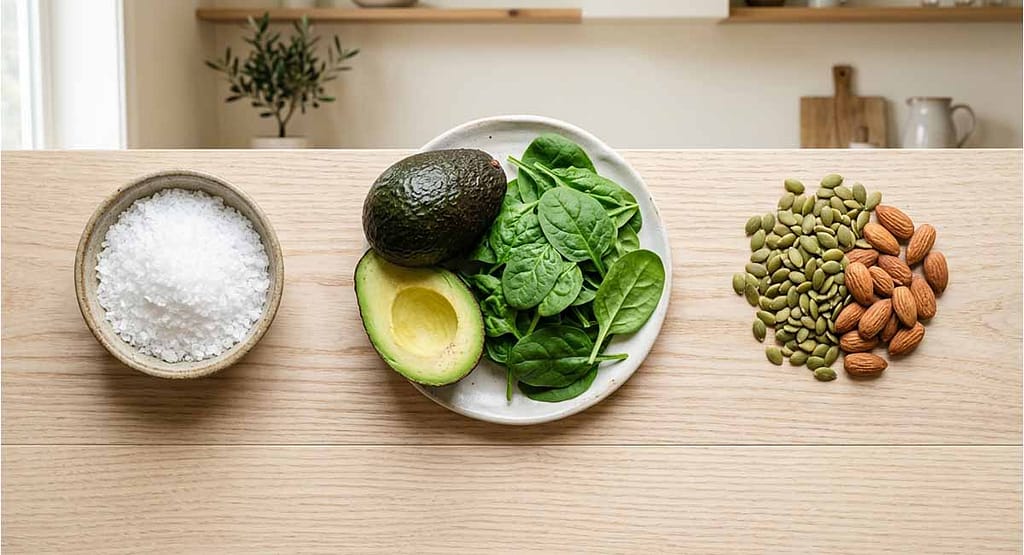
| Electrolyte | Daily target on keto | What it does | Easy keto food sources |
|---|---|---|---|
| Sodium | 3,000–5,000 mg | Fluid balance (the mineral you lose most) | Salt your food, broth/bouillon, pickles, olives |
| Potassium | 3,000–4,700 mg | Muscle contraction (fights cramps) | Avocado, spinach, salmon, mushrooms |
| Magnesium | 300–500 mg (supplement ≤ 400 mg) | Energy metabolism (helps sleep + cramps) | Pumpkin seeds, spinach, almonds, dark chocolate |
Sodium & magnesium targets via Virta Health; potassium via Diet Doctor; the three key minerals via Cleveland Clinic. A simple way to hit sodium without counting milligrams: salt to taste, add about 2 g of sodium from broth or bouillon, and eat 5 servings of non-starchy vegetables a day (Virta’s approach). One quick conversion so you don’t mix up “salt” and “sodium”: 1 teaspoon of salt ≈ 5 g of salt ≈ 2,300 mg of sodium — the rest is chloride. Two honest cautions: go easy on potassium and magnesium supplements (they have a narrower safe range — food is safer), and if you take blood-pressure or diuretic medication, ask your doctor before loading up on sodium.
Keto Flu vs. the Real Flu: How to Tell
Because it borrowed the name, a lot of beginners panic that they’ve caught an actual virus. Here’s the quick tell. The keto flu starts within a few days of cutting carbs, comes without a fever, isn’t contagious, and improves fast once you fix electrolytes and hydration — it’s a diet-transition effect. The real flu is a contagious viral infection: it usually brings a fever, body aches, and sometimes a cough or sore throat, it spreads to other people, and no amount of salt or broth touches it — it needs time and rest.
The simplest rule of thumb: if it lines up with the day you slashed your carbs and eases when you replenish minerals, it’s the keto flu. If you’re running a temperature, everyone in your house is sick too, or things are getting worse instead of better, treat it as a real illness and check in with a doctor.
How to Prevent the Keto Flu Before It Starts
The best keto flu is the one you never fully get — and prevention is mostly about front-loading electrolytes instead of waiting for symptoms. Start salting your food and sipping broth from day one, before you feel bad; by the time the headache arrives on day 3, you’re already behind. Keep your net carbs where they need to be — under 20–30 g a day to start, and generally below 50 g, per Diet Doctor — because half-in, half-out carb levels can drag the adaptation out.
Hydrate steadily, but always pair water with sodium. And use timing to your advantage: start on a Thursday so days 3–4 (the peak) land on the weekend when you can rest. If a cold-turkey drop wrecked you last time, easing carbs down over a few days is a perfectly valid way to prevent the worst of it.
Do You Actually Need an Electrolyte Supplement?
Honest answer: not necessarily. Plenty of people beat the keto flu with nothing more than extra salt, broth, and electrolyte-rich whole foods like avocado and leafy greens — that’s the cheapest, safest route, and I’d try it first.
Where a supplement earns its place is convenience and consistency: if you struggle to hit sodium and magnesium from food, cramp up at night, or just want a no-math option, a well-formulated keto electrolyte powder can make week one a lot smoother. The catch is that many popular “hydration” powders are loaded with sugar or barely contain any sodium — the exact mineral you need most — so the label matters more than the marketing.
I compared the specs (sodium, potassium, magnesium, and hidden carbs) against the clinical targets in this post over in my best keto electrolyte powder review, so you can see which ones actually hit the numbers and which are just pretty packaging. Bottom line: food first, supplement only if it makes sticking with keto easier.
Who Should Be Careful — Keto Flu Reality-Check
Two honest truths before you white-knuckle through symptoms. First, who should talk to a doctor before starting keto at all: if you’re pregnant or breastfeeding, have kidney, liver, or pancreas disease, or have a history of an eating disorder, please get personalized advice first. If you take blood-pressure or diuretic medication, loading sodium can interact with it — check in before you do.
And one hard flag: if you take an SGLT2 inhibitor for type 2 diabetes, combining it with keto can raise your risk of diabetic ketoacidosis (a medical emergency), per Healthline — talk to your doctor first. Second, set your expectations: that dramatic weight drop in week one is mostly water, not fat — glycogen holds water, so when you burn it, the water leaves too, per Perfect Keto. Real fat loss is slower and steadier. Knowing that ahead of time is how you sail past the exact moment most beginners quit.
📌 Ready to get ahead of it? Grab my free Keto Starter Kit — the printable electrolyte cheat sheet and food list travel straight to the store with you, so week one is smooth from day one.
Keto Flu FAQ
-
What is the keto flu?
The keto flu is a set of temporary, flu-like symptoms — headache, fatigue, brain fog, irritability, and muscle cramps — that some people feel in the first days of a very low-carb diet. It’s caused by the loss of water and electrolytes as your body enters ketosis, not by a virus, and it isn’t contagious.
-
How long does the keto flu last?
For most people it begins within a few days, peaks in week 1, and clears in a median of about 4–5 days. A minority feel it for up to about 4 weeks. If symptoms drag well past two weeks, revisit your electrolytes and calories.
-
How do I get rid of the keto flu fast?
Replace electrolytes — especially sodium (3,000–5,000 mg), plus potassium and magnesium — drink water alongside the salt, eat enough fat and calories, and rest. Most people feel noticeably better within a day or two of getting sodium right.
-
Is the keto flu a sign that keto is working?
Sort of — it usually overlaps with entering ketosis (around day 3–4), because the same water-and-mineral flush that switches on ketosis triggers the symptoms. But you don’t need to suffer for it to work; fixing electrolytes early can prevent most of it without slowing your progress.
-
Can you avoid the keto flu completely?
Often, yes. Front-load electrolytes from day one, hydrate with sodium (not just plain water), keep net carbs under 20–30 g, and consider starting on a Thursday so the peak lands on the weekend. Easing off carbs over a few days also softens it.
-
Is the keto flu dangerous?
For most healthy people, no — it’s uncomfortable but temporary. See a doctor if you have a fever, vomiting, or symptoms that worsen instead of improve, or before starting keto at all if you’re pregnant, have kidney/liver/pancreas disease, or take diabetes, blood-pressure, or diuretic medication.
Everything here is educational and honest to the best of my research — not medical advice. For your personal situation, please loop in your doctor. You’ve got this — and week one really does end. — Tristina


