

How to Start Keto: Your Simple 7-Day Beginner Guide
Medical note: I’m Tristina — a home cook and keto researcher, not a doctor or dietitian. This plan is educational, not medical advice. If you’re pregnant, have a health condition, or take medication, please talk to your doctor before starting keto (I cover exactly who should be careful in the Reality-Check section below).
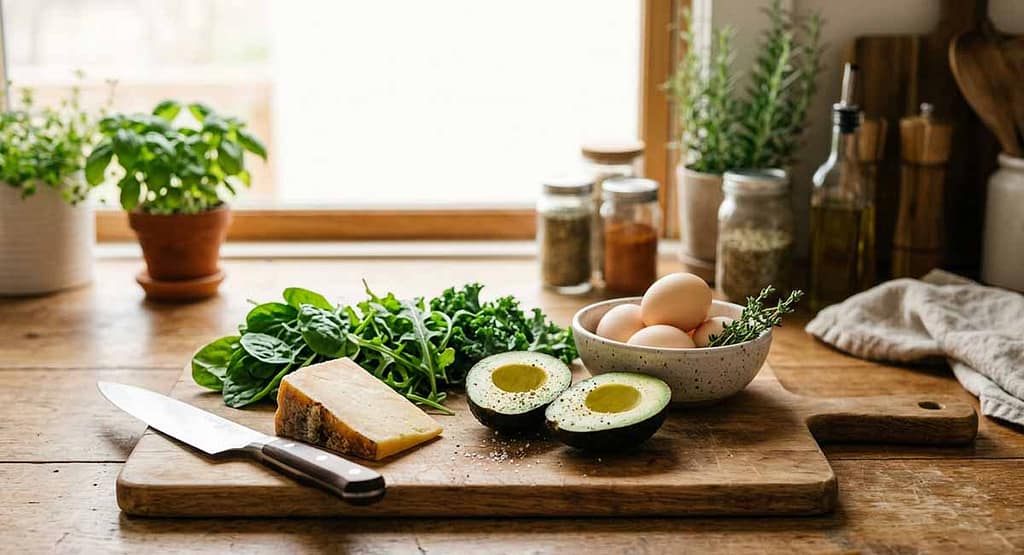
How to start keto, in one breath: pick a carb limit — under 20–30 grams of net carbs a day — clear the carbs out of your kitchen, build every plate from fat, protein, and non-starchy veg, salt your food well, and give your body about a week to switch from burning sugar to burning fat. That’s the entire on-ramp. No fancy products, no calorie math on day one.
If the internet has made starting keto feel like a research project, I get it — that’s exactly why I wrote this. Think of this as the do-this-now companion to my complete keto for beginners guide: that one explains the what and the why, and this one is the step-by-step how. Here’s my honest promise: no fluff, no fake before-and-afters, just the simple 7-day plan I’d hand a friend who wants to start this week.
I’ll walk you through the five steps, give you a full day-by-day meal plan you can save, and tell you honestly what to expect — including the rough patch and how to sail past it. My first week wasn’t perfect—I honestly thought I couldn’t survive without bread. But once I cleared out my pantry and focused on cooking simple, whole-food meals at home, my sugar cravings finally vanished, and that’s when I knew this was sustainable for me.
📌 Want the whole week done for you? Grab my free Keto Starter Kit — a printable meal plan + grocery list you can take straight to the store.
Table of Contents
How Do You Start Keto in 5 Steps?
To start keto, you don’t need a coach or an app — you need five moves, in order. Step 1: set your carb limit at under 20–30 g net carbs a day. Step 2: clear your kitchen of bread, pasta, sugar, and snacks, then restock with keto basics. Step 3: build every plate from a protein, a fat, and a non-starchy vegetable. Step 4: salt your food from day one to head off the “keto flu.” Step 5: pick your start day — ideally a Thursday — and give your body about a week to adapt.
Do these five things consistently and ketosis takes care of itself. Everything below is just each step in plain detail, plus a 7-day plan so you’re never guessing what to cook. Start simple; you can fine-tune later.
Step 1 — Set One Carb Limit and Ignore the Rest
The single number that makes keto work is your carb limit. Diet Doctor recommends starting under 20–30 g of net carbs per day, and generally staying below 50 g, to reliably reach ketosis. “Net carbs” means total carbs minus fiber — so the fiber in leafy greens and avocado barely counts against you. That’s the one rule to obsess over in week one.
Here’s my honest advice: don’t count calories or fat grams yet. Trying to track every macro on day one is how beginners burn out by day three. Nail the carb limit, eat until you’re satisfied, and let the rest sort itself out. If you’re the type who likes exact numbers, I show you how to dial them in with my keto macros guide — but it’s optional for now. One limit, one focus. Keep it that simple.
Step 2 — Clear Your Kitchen, Then Restock
Willpower fails; a clean kitchen doesn’t. Before day one, do a quick sweep: move the bread, pasta, rice, cereal, sugary snacks, and soda out of easy reach. You don’t have to throw good food away — box it, donate it, or push it to a high shelf — but get it out of your line of sight.
Then restock with the keto staples you’ll actually reach for: eggs, meat, fish, cheese, butter, olive oil, avocados, and non-starchy veg like leafy greens, broccoli, and zucchini. This one-time reset removes about 90% of the daily “should I?” decisions before they happen. Not sure whether a food makes the cut? That’s exactly what my complete keto food list is for, and my store-by-store keto grocery list turns it into a cart you can fill in one trip. Shop once; coast all week.
Step 3 — Build Every Plate the Same Way
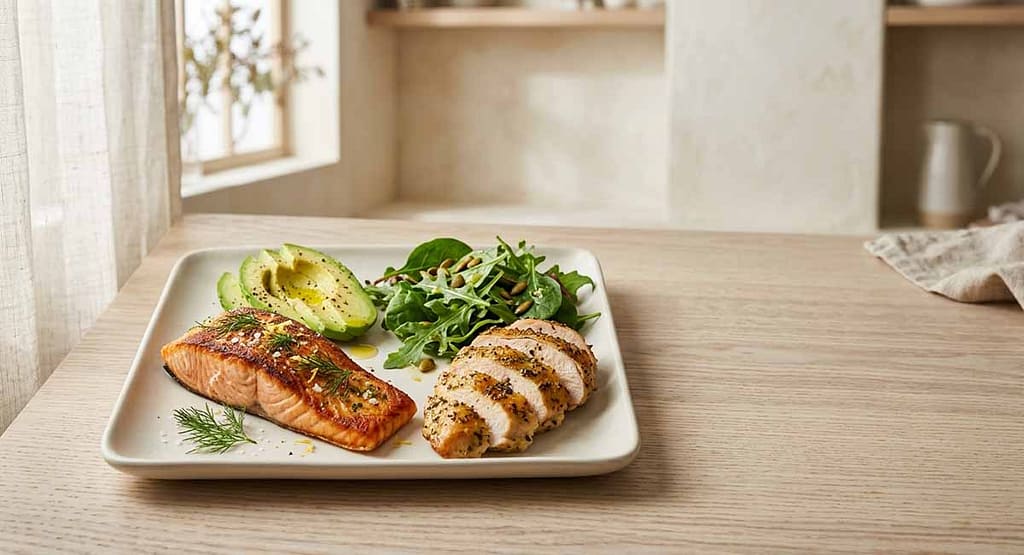
Keto cooking gets easy the moment you stop thinking in recipes and start thinking in a formula: a protein + a fat + a non-starchy vegetable. Grilled chicken, olive oil, and a big salad. Salmon, butter, and roasted broccoli. Eggs, avocado, and spinach. That’s it — swap the carb on your old plate for extra veg or fat and you’ve built a keto meal.
On the numbers, Harvard’s Nutrition Source puts standard keto around 70–80% of calories from fat, 10–20% from protein, and 5–10% from carbs — roughly 165 g fat, 75 g protein, and 40 g carbs on a 2,000-calorie day. But you don’t need to hit those to the gram. Keep protein moderate (not sky-high), let fat carry the meal, and keep carbs tiny. The formula does the math for you.
Step 4 — Salt Your Food From Day One
This is the step most beginners skip, and it’s the one that decides whether week one feels fine or awful. When you cut carbs, insulin falls and your kidneys flush out extra sodium and water — and the electrolytes go with them, which is what causes the “keto flu.” The fix is minerals, starting on day one, not day four. Cleveland Clinic flags three to watch: sodium, potassium, and magnesium. Here are the common daily targets on keto:

| Electrolyte | Common daily target on keto |
|---|---|
| Sodium | 3,000–5,000 mg |
| Potassium | 3,000–4,700 mg |
| Magnesium | 300–500 mg (supplement ≤ 400 mg) |
For reference, 1 teaspoon of salt ≈ 2,300 mg of sodium, so salting your meals plus a cup of broth covers most of it. My full keto flu guide breaks down each one. (Targets: Virta Health, Diet Doctor, Cleveland Clinic.)
Step 5 — Start on a Thursday (Yes, Really)
Here’s a trick no one told me, and it’s free: start your keto week on a Thursday. The reason is timing. Keeping carbs strict, most people reach ketosis in about 2–4 days (usually around day 4), according to WebMD — and days 3–4 are also when the keto flu tends to peak. If you start on a Thursday, those two draggy days land on Saturday and Sunday, when you can rest, sip broth, and nap instead of white-knuckling a Monday meeting.
By the time work rolls around, you’re usually through the worst of it and your energy is climbing back. It’s a small scheduling choice that removes a big chunk of the “keto is miserable” experience. Want the biology behind that timeline — what’s actually happening inside your body each day? I lay it out in my what is ketosis guide. For now, just circle a Thursday.
Your 7-Day Keto Meal Plan (Save This)
Most guides tell you to “plan your meals” and then hand you nothing. So here’s an actual plan — seven days of simple, repeatable, beginner-friendly meals that sit comfortably under your carb limit. Nothing here is fancy or expensive, and leftovers are built in on purpose. Repeating a breakfast is a feature, not a failure: fewer decisions, fewer chances to slip. Screenshot this table and stick it on the fridge.
| Day | Breakfast | Lunch | Dinner | Today’s focus |
|---|---|---|---|---|
| Thu (1) | Scrambled eggs in butter + avocado | Tuna salad in lettuce cups, olive oil | Salmon + roasted broccoli | Salt every meal from the start |
| Fri (2) | Eggs + bacon | Big salad, grilled chicken, cheese, olive oil | Burger patties (no bun) + sautéed greens | Drink water; add a cup of broth |
| Sat (3) | Cheese omelet + avocado | Leftover burger patties + salad | Baked chicken thighs + zucchini | Keto flu may hit — rest, broth, electrolytes |
| Sun (4) | Eggs + smoked salmon | Chicken + cauliflower rice stir-fry | Pork chops + buttered green beans | Keep resting; keep salting. It passes |
| Mon (5) | Scrambled eggs + avocado | Cobb salad (egg, chicken, bacon, avocado) | Salmon + asparagus in olive oil | Energy returning — stay consistent |
| Tue (6) | Full-fat Greek yogurt + a few berries | Leftover salmon + greens | Beef & broccoli stir-fry (no rice) | Notice fewer cravings? That’s ketosis |
| Wed (7) | Eggs + bacon | Big salad, chicken, olive oil, cheese | Roast chicken + cauliflower mash | Plan next week — you’ve got the rhythm |
Snacks (as needed, not required): a handful of macadamia nuts or almonds, cheese, olives, hard-boiled eggs, or veggie sticks with guacamole. Drink water all day and salt to taste.
📌 Want this plan as a printable for the fridge? It comes with a matching grocery list in my free Keto Starter Kit — one download, whole week sorted.
What to Expect Day by Day
Knowing what’s coming is half of not quitting. Days 1–2 usually feel pretty normal as your body burns through its stored sugar. Days 3–4 are the turning point — this is when most people reach ketosis and when the keto flu, if it shows up, tends to peak: think headache, fatigue, or brain fog. It’s temporary. A 2020 review in Frontiers in Nutrition found symptoms most often clear in about 4–5 days, with a minority feeling them for up to a few weeks. By days 5–7, energy climbs, cravings fade, and your head clears.
| Days | What you may feel | Your move |
|---|---|---|
| 1–2 | Pretty normal | Cut carbs, salt your food, hydrate |
| 3–4 | Keto flu may hit; you enter ketosis | Broth + water + electrolytes; rest |
| 5–7 | Energy up, cravings down, clearer head | Stay consistent; don’t add carbs back |
Keto Reality-Check: Who Should Wait & What Won’t Happen
Honesty matters more than hype, so two things before you start. First, keto is safe for most healthy people, but it’s genuinely not for everyone. Talk to your doctor first if you’re pregnant or breastfeeding, have kidney, liver, or pancreas disease, have a history of an eating disorder, or take medication for blood pressure or diabetes. One hard warning: if you take an SGLT2 inhibitor for type 2 diabetes, combining it with keto can raise your risk of a dangerous condition called diabetic ketoacidosis (DKA) — check with your doctor before starting.
Second, let’s set expectations so you don’t quit on day 5 feeling cheated: that fast drop on the scale in week one is mostly water, not fat. Carbs make your body hold water; burn through them and the water leaves too. Real fat loss is steadier and shows up after your body adapts. Knowing that upfront is what keeps beginners going right when it’s about to pay off. (Sources: Healthline, Virta, Diet Doctor, National Lipid Association.)
📌 Ready to start this Thursday? Take my free printable Keto Starter Kit (7-day meal plan + grocery list) straight to the store and skip the guesswork.
How to Start Keto: FAQ
-
How do I start keto as a beginner?
Set a carb limit under 20–30 g net carbs a day, clear the carbs from your kitchen and restock with keto basics, build every plate from protein + fat + non-starchy veg, salt your food from day one, and give your body about a week to adapt. Start simple; skip macro-counting at first.
-
How many carbs can I eat to start keto?
Start under 20–30 g of net carbs per day (net = total carbs − fiber), and generally stay below 50 g, per Diet Doctor. Lower is more reliable for reaching ketosis in your first week.
-
How long until keto starts working?
Keeping carbs strict, most people reach ketosis in about 2–4 days (often around day 4), per WebMD. It can take a week or longer depending on your metabolism, activity, and what you ate before starting.
-
Do I have to count macros to start?
Not at first. As a beginner, just hit your carb limit and eat protein + fat until satisfied. Precise macro tracking helps later if your progress stalls — it’s not a day-one requirement.
-
How do I avoid the keto flu when starting?
Salt your food from day one and get enough sodium, potassium, and magnesium. When you cut carbs, your body sheds water and electrolytes, which triggers the symptoms. Broth, water, and salted meals usually prevent the worst of it.
-
What’s the easiest first week of keto meals?
Repeat simple plates: eggs and avocado for breakfast, big salads with chicken or tuna for lunch, and salmon, chicken, or beef with a non-starchy veg for dinner. Use the 7-day table above — repeating meals is a feature, not a failure.
Everything here is educational and honest to the best of my research — not medical advice. For your personal situation, please loop in your doctor. You’ve got this — one Thursday at a time. — Tristina


